


advanced treatment for polishing associating ozonation and biological treatment – Oxyblue®
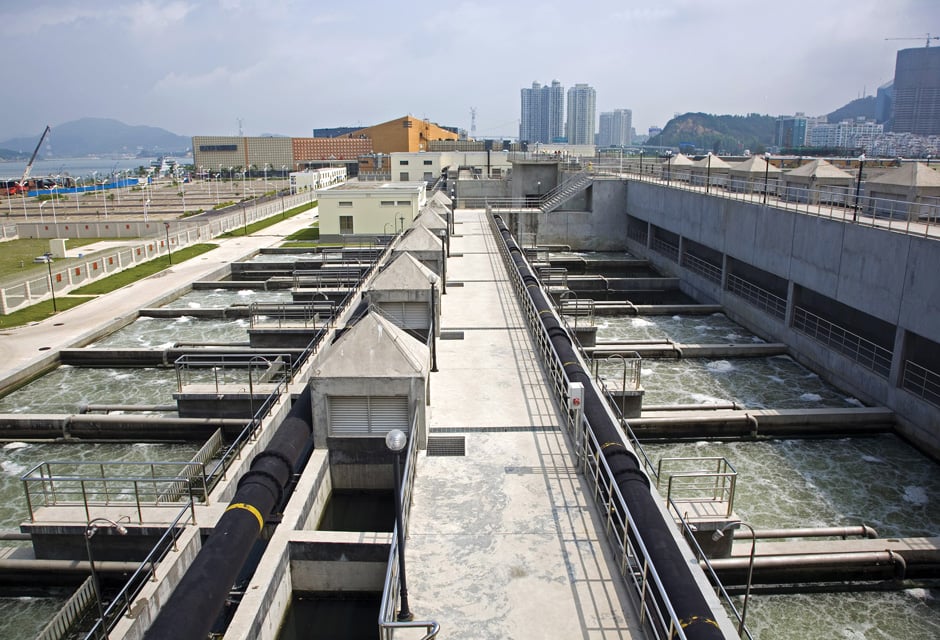
Tertiary or quaternary ozonation, frequently used in combination with other processes, improves the quality of treated effluents by targeting persistent organic matter, particularly organic micropollutants and refractory compounds.
Oxyblue® is applied as a final step before discharge or integrated into a more or less complex process to produce high-quality water that can be reused.
Oxyblue® consists of a synergistic chemical/biological oxidation system: it combines ozonation and biological treatment.
The Oxyblue® solution exploits ozone's ability to convert organic pollutants into more oxygenated and therefore more biodegradable compounds.
The synergy between the chemical and biological processes works as follows:
- The elimination of organic pollution is initiated by ozonation. Ozone is applied using the precise dose required to partially oxidize the organic pollutants.
- The elimination of organic pollution continues through biological oxidation, benefiting from 1) the oxygen supply resulting from ozonation, 2) the promoting effect related to additional phenomena such as adsorption and retention on biomass support media.
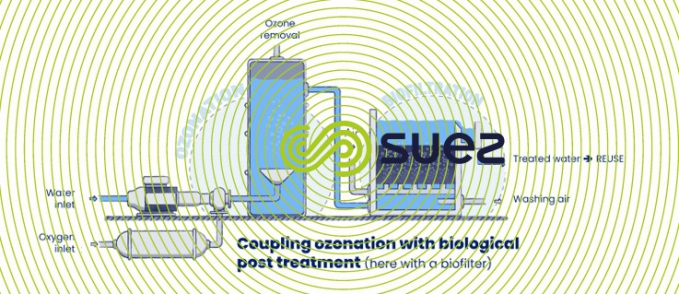
The integrated Oxyblue® installation comprises two main units:
• Ozonation contactor such as bubble column or venturi/static mixer system, fed by clarified effluent and ozone gas,
• Biological system: filtration onto sand filtration (Aquazur®) or granular activated carbon (Carbablue®), aerated biofiltration (Biofor® aerated).

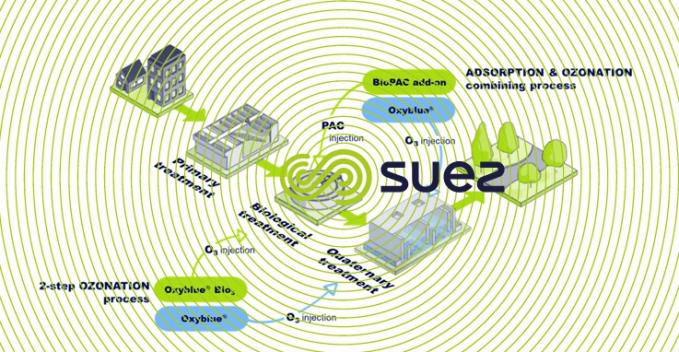
The Oxyblue® Bio3 variant integrates ozonation directly applied into the biological treatment process. It eliminates both micropollutants in the water and those adsorbed in sludge or suspended solids.
Multi-point treatments are also possible to enhance the effectiveness of the biological treatment and achieve a high level of performance.
This is particularly the case with the combination of Oxyblue® Bio3 + Oxyblue® Ozone:
- Stage 1: ozone injection during biological treatment
- Stage 2: ozone injection during quaternary treatment
key figures
Application Micropollutants in urban wastewaters
- Over 80% elimination of micropollutants or reduction below the predicted environmental concentration (PNEC).
- Up to 40% reduction in micropollutants in sludge thanks to the addition of ozone during the biological treatment phase (Oxyblue® Bio3 + Oxyblue®)
Application COD in industrial wastewaters
- Up to 60% of COD eliminated
- Decrease of up to 50% of reagent consumption for membrane washing
among references
Application Micropollutants in urban wastewaters
- Sofia-Antipolis, France : ERU 50,000 PE (Oxyblue)
- Hospital central d’Aalborg, Danemark : 400 PE (Oxyblue with MBR and PAC addition)
Application DCO en eaux résiduaires industrielles
- PetroChina Company, Chengdu (Chine) 1,600 m3/h (Oxyblue with Biofiltration)
- PetroChina Company, Yunnan (Chine) 1,200 m3/h (Oxyblue with Biofiltration)
Oxyblue
- Is useful to control the formation of potentially toxic by-products that can result from extensive ozonation treatment
- Produces beneficial results in terms of toxicity, disinfection, color, and odor
- Allows effluent discharge in sensitive areas
- Has a small footprint and is modular in design
- Quickly adapts to variations in load and flow rate
- Is a competitive technology compared to other common competing technologies (ozonation and activated carbon adsorption)
- Leads to a significant reduction in the consumption of washing reagents and an increase in the longevity of ultrafiltration equipment installed downstream in reuse systems.
Bookmark tool
Click on the bookmark tool, highlight the last read paragraph to continue your reading later
